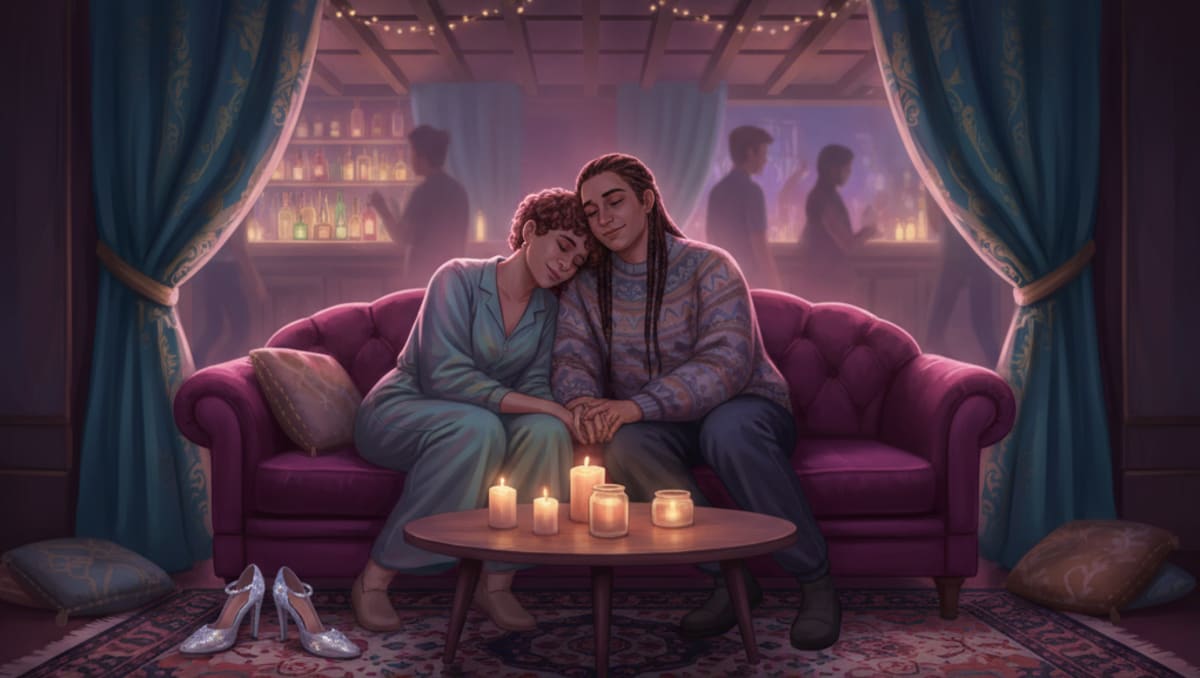
When people first hear about She Came at the Glass Heel, they usually picture one thing: a glamorous queer nightclub where the lights are low, the music is loud, and the sex is unapologetically front and center.
They’re not wrong.
The Glass Heel absolutely is a place of desire. It’s a club where women come to explore kink, experiment with fantasy, and step into versions of themselves they might never reveal in daylight. There are bodies on the dance floor, private rooms behind velvet curtains, and moments of heat that change the way a character understands her own hunger.
But from the very beginning, The Glass Heel has never been just a sex club in my mind. It’s a sanctuary.
Every woman who walks through those doors is crossing a threshold. Some are there for a wild weekend away from a life that feels too small. Some are there to test the edges of a fantasy they’ve only ever dared to imagine. Some are there because they’re standing at a crossroads—between one version of their life and another, between hiding and being seen. The Glass Heel is where those transitions happen. It’s not just a backdrop for erotic scenes; it’s a liminal space. A place where a character can say, “What if I didn’t have to be the person I am outside these walls? What if I could be the person I’ve only ever been in my head?” That’s sanctuary: not just safety from harm, but safety to become.
The Glass Heel is also a queer space, and that matters. Queer communities have a long, quiet history of building refuge for each other when the world refuses to. Bars, clubs, back rooms, house parties, chosen family apartments—these are the places where people have gone to be themselves, to be held, to be seen without explanation. The club’s staff and regulars carry that legacy. The bouncer who knows when someone is coming in with more than just nerves. The bartender who can read the difference between “I’m shy” and “I’m scared.” The owner who remembers what it felt like to have nowhere safe to go—and decides no one else will feel that alone if she can help it. Yes, there’s flirting and spectacle and sex. But under all of that is a culture of watching out for each other. Of making sure no one gets lost in the crowd unless they want to disappear for a while—and even then, someone is keeping an eye on the exits.
One of the ways The Glass Heel functions as sanctuary is through the way consent is baked into its bones. Consent here isn’t a box to check before the fun starts; it’s part of the atmosphere. It’s in the way staff intervene when a scene looks off. It’s in the club rules about touch, negotiation, and aftercare. It’s in the unspoken understanding that “no” is never a problem, and “I changed my mind” is always allowed. For many characters, this is the first time they’ve been in a space where their boundaries are taken seriously without question. That alone can be transformative—especially for women who have been taught that their comfort is negotiable, or that their pleasure is secondary. Sanctuary doesn’t mean nothing hard ever happens. It means that when it does, there are structures and people in place to hold you through it.
There’s a cultural habit of treating erotic spaces as inherently dangerous or corrupting, especially when they’re queer, kinky, or centered on women’s pleasure. Part of what I’m doing with The Glass Heel is pushing back against that idea. In this world, desire and safety are not opposites. A woman can be half-wild on the dance floor and still know she’s protected. She can kneel at someone’s feet and still be fully in control of her choices. She can walk into a private room with her heart pounding and know that if she says “stop,” everything stops. The sanctuary of The Glass Heel isn’t about wrapping characters in bubble wrap. It’s about giving them a place where they can risk more—emotionally, erotically, spiritually—because the foundation beneath them is solid.
Not every story set at The Glass Heel will be light. Some women arrive carrying grief, shame, or the echoes of harm done elsewhere. Some are trying to remember what it feels like to want anything at all. Some are learning that they’re queer, or kinky, or simply not broken for wanting what they want. The club holds them, too. Sometimes that looks like a wild, joyful weekend that reminds them they’re still alive. Sometimes it looks like a quiet conversation in a back hallway. Sometimes it’s a room upstairs, a soft bed, a locked door, and the first good night’s sleep they’ve had in months. Those stories are just as erotic to me as the hottest scene on the dance floor—because they’re about reclaiming the right to feel, to want, to be held.
I didn’t want to write a series where the club was just a backdrop for sex. I wanted to write about a place that feels like home for people who have been told, over and over again, that there is no home for them. The Glass Heel is a sanctuary because it offers more than orgasms and spectacle. It offers belonging for those who’ve been othered, witnessing for those whose pain has been ignored, and possibility for those who can’t yet imagine a life beyond survival. And yes, it offers pleasure—messy, joyful, complicated, transformative pleasure.
As the series unfolds, you’ll see different corners of that sanctuary: the glittering public spaces, the shadowed private rooms, and the quieter, hidden places where people go when they need to fall apart or start again. Because in the end, The Glass Heel isn’t just where women go to be watched. It’s where they go to be seen.